Showing posts with label too good to miss. Show all posts

Tuesday

Pay it forward


  • International Pay it Forward Day is 

    Thursday, April 28, 2016

  • Pay it Forward Day UK
  • Pay It Forward Foundation

  • International Pay It Forward Day

    Pay it forward is an expression used when someone who is done a good deed repays it to others not the original benefactor. The concept is old, but the term is quite recent:

    • First use of the term may have been by Lily Hardy Hammond in her 1916 book In the Garden of Delight: "You don't pay love back; you pay it forward."
    • The Pay it forward concept was the key plot element in an ancient Greek play from 317 BC called Dyskolos by Menander.
    • The concept was described by Benjamin Franklin, in a letter to Benjamin Webb dated April 25, 1784:
    I do not pretend to give such a deed; I only lend it to you. When you [...] meet with another honest Man in similar Distress, you must pay me by lending this Sum to him; enjoining him to discharge the Debt by a like operation, when he shall be able, and shall meet with another opportunity. I hope it may thus go thro' many hands, before it meets with a Knave that will stop its Progress. This is a trick of mine for doing a deal of good with a little money.
    • The term "pay it forward" was used by Robert A. Heinlein in his book Between Planets, published in 1951
    • In 2000, Catherine Ryan Hyde's novel Pay It Forward was adapted into a film of the same name, starring Kevin Spacey, Helen Hunt and Haley Joel Osment. It describes creating a social movement of doing good deeds to make the world a better place.

    Wednesday

    You can make a safer world for kids

    Every parent, grandparent and carer wants to keep their child healthy and safe...right? Well here is a wonderful resource that can help you make a safer world for children - 

    A Parent’s Guide to Keeping Your Kids Alive and Safe

    resource that helps parents Keep Kids Safe
    To use the actual guide go here
    This informative page has been created by physicians at ACLS Medical Training. It describes some simple steps parents can take to help make children safer including helmet safety, kitchen safety, seat belt and child passenger safety. 

    The fun thing is that it is all done through an interactive page that outlines 14 tips you can use to make your world a safer place for children. How to approach a strange dog, how to keep your internet safe, the best placement for smoke detectors in the home are all explained.

    This factual addition to your safety knowledge provides useful reminders with links to expert, up to date and more detailed information on each of the topics seen in the image. A Parent’s Guide to Keeping Your Kids Alive and Safe helps make a safer world for kids. 

    The good news is that you can help protect children from injury by being informed.  

    Thursday

    Simple Life: simple letter of thanks

    Are you fascinated by the enigmatic Marilyn Monroe?
    Here is a letter she wrote - a charming, short and simple letter that gets straight to the point but shows some of the writer's personality:

    Marilyn Monroe letter
     
    Transcript of the letter
    Mr. Volkmar von Fuehlsdorff
    German Consulate General
    3450 Wilshire Boulevard
    Los Angeles 5, California

    Dear Mr. von Fuehlsdorff:

    Thank you for your champagne.

    It arrived, I drank it and I was gayer.

    Thanks again.

    My best,

    Marilyn Monroe

    Friday

    The Cheapskate Guide

    frugal friday

    Confession time: I’m a cheapskate. Some would say frugal, which sounds much more positive, but in reality I can be a real cheapskate.

    I am fairly frugal (though not always), but sometimes I take it too far: I have T-shirts with holes in them, I never buy new clothes, we’re shopping for a new couch because our current one has holes in it, and I ran my current pair of running shoes until the soles fell off.

    However, I have gradually learned to be frugal in many ways that I would recommend to others. I don’t think you should have holes in your couch, and you should definitely replace your running shoes more often than I do, but there are many ways to cut back on spending and live a more frugal lifestyle.

    Why live frugally? First, because it allows you to spend less than you earn, and use the difference to pay off debt, save or invest. Or all three. Second, because the less you spend, the less you need to earn. And that means you can choose to work less, or work more but retire early. Or take mini retirements. You have more options with a frugal lifestyle.

    I know what I’m going to hear in the comments, because it’s been done repeatedly with my other frugal articles: I have no life. This is boring. I might as well live in a box. You have to enjoy life sometimes.

    All of which you might believe, but I believe I do have a life. A great one. One where I spend time with my family, where I have conversations and read and get outside and do things that are fun and exercise and focus on what’s important and spend my free time the way I want. This is a good life. Read this article for more.

    So, if you’d like some tips on frugal living, here are just a few, from a cheapskate. I should note that I do most, but not all, of these tips.
    1. Go with one car. Many families have two or more cars. Besides your house, your car is probably your most expensive item. If you can do with one, you should. My wife and I both work, and we have six kids, and yet we have learned to manage with one car.
    2. Go with a smaller house. Just because you can afford a larger house, doesn’t mean you should live in one. Live in as small a house as you can and still be comfortable. I don’t mean you should live in a one-room apartment with a family of four … you know what I mean. You can save thousands a year with a smaller house. Many times, if you get rid of a lot of clutter, you don’t need a large house.
    3. Go with a smaller car. Again, you can save thousands by going with a smaller car. A car instead of an SUV, for example, is a big savings. Be comfortable, but don’t overdo it. You’ll save a lot on gas this way too.
    4. Rent rather than own. This will probably spark a huge debate, as it always does. The thing is, just don’t assume that buying is the better investment. If you calculate the interest you pay on a mortgage, the cost of insurance and maintenance, buying is often much more costly than renting … and if you rent, save money, and then invest the difference, you can actually end up well ahead in the long run. Now, it’s not a given, so do a comparison, factoring in all expenses. Here’s a more in-depth article.
    5. Look for used first. If you need something — I mean really need it, not just want it — see if someone you know has one that they don’t use or need anymore. Send out an email to family or friends, or just ask around. You might be surprised. I was about to buy a printer, and then found out my mom just bought a laser printer and didn’t need her old inkjet … saving me close to 100 smackeroos. If no one you know owns one, try freecycle.org or craigslist.org. Then look to buy used, at garage sales or thrift shops. You can find a bargain if you look around.
    This is just the first 5 tips from Leo Babauta of Zen Habits. There are 45 more! We will post some each Friday for our day of frugality.

    Frugal Friday FAQ: Cheapskate Confessions & Clarifications

    What does it mean to be frugal?

    Being frugal means spending with intention. It’s not about deprivation — it’s about choosing what truly matters and letting go of what doesn’t. Frugality asks: Is this worth my time, money, and energy? If not, it’s a pass.

     Is frugality the same as being cheap?

    Not quite. A cheapskate might skip tipping or buy the lowest-quality item just to save a buck. A frugal person looks for value — they’ll spend where it counts (like good shoes or healthy food) and cut back where it doesn’t (like brand names or impulse buys). Frugality is thoughtful. Cheapness is reactive.

    Why would anyone choose to live frugally?

    Because frugality gives you freedom. Spend less, and you can:

    • Pay off debt

    • Save for emergencies or retirement

    • Work less or retire earlier

    • Stress less about money

    • Focus more on relationships, health, and joy

    It’s not about living in a box — it’s about living on your own terms.

    Isn’t frugal living boring?

    Only if you think joy comes from spending. Many frugal folks find fun in:

    • Free community events

    • Nature walks and backyard picnics

    • DIY projects and thrift treasure hunts

    • Game nights, potlucks, and slow mornings

    • Reading, creating, and connecting

    Frugality isn’t the absence of fun — it’s the presence of purpose.

     How do I start being frugal without feeling deprived?

    Start small:

    • Buy used instead of new

    • Cook at home more often

    • Cancel subscriptions you don’t use

    • Ask “Do I really need this?” before buying

    • Celebrate every dollar saved as a step toward freedom

    Frugality is a practice, not a punishment. And like any practice, it gets easier — and more rewarding — over time.


    Cheapskate Guide


    Sunday

    Recycled Art

    Creating good things that are unique and visually inspiring from materials that may have otherwise been thrown out is what these artists are all about. Look at these treasures made from trash...

    Recycled Art from an exhibition at Napa Valley Museum
    Giant Spiral by Rob Petit made from old mobile phones.
    Rob creates only with phones and sometimes incorporates light.

    recycled art
    Roman Party Dress by Janet Cooper

     
    Moth and Butterfly sculptures by Michelle Stitzlein
    who has been creating sculptures with recycled materials since before 2000

    Tuesday

    Being Happy in Unhappy Circumstances


    It seems that every day life is getting more and more difficult.  We no longer have to turn on the TV to hear stories of heart ache anymore.  Talk to any of your friends, family, or neighbors and I’m sure you’ll find hard times have hit closer to home than we are used to.  Yes, hard things are happening.  But that doesn't mean that we have to become hard. 
     
    I believe that we can be happy even in unhappy circumstances. 
    How?   In the book “The How of Happiness” Sonja Lyubomirsky states that 50 percent of a given human’s happiness level is genetically determined (based on twin studies), 10 percent is affected by life circumstances and situation, and a remaining 40 percent of happiness is subject to self-control.  Isn't that interesting!  Only 10 percent is affected by life, and 40 percent is subject to self-control.  I find that amazing, and contrary to popular belief.  If that is true, then we do have the ability to choose to be happy.  So, how do we do that?
       
    Here are a few things I believe will help us to be happy in unhappy circumstances.
      
    1. Help Others.  Feeling down about yourself or your life?  The best antidote for that, in my opinion, is doing something for someone else.  Seriously, it's like magic!  While we are helping someone else our own sadness disappears.  And it's not just by doing grand acts, small acts of kindness are just as helpful.  A familiar quote says, "if you see a friend without a smile give him one of yours.”  Sometimes that's all it takes. 

    2. Be optimistic.  The definition of optimism is "A tendency to expect the best possible outcome or dwell on the most hopeful aspects of a situation."  Sometimes it's hard to "expect the best possible outcome", but I like that second part, dwell on the most hopeful aspects of a situation.  Ahhh, dwelling.  We are all prone to dwell on things now and then.  Why not embrace it by dwelling on the good instead of the bad!  See the good in situations.  Look for it.  Write it down.  Be thankful for it.  Tell others the good things going on instead of the bad.  If you can make that a habit, you'll be much happier.  "I can complain because the rose bushes have thorns or rejoice because the thorn bushes have roses", J. Kenfield Morley.  Be an optimist!

    3. Don't give up.  Take a break, have a cry, call your best friend, but DO NOT QUIT.  

    The following poem always helps me find the strength to carry on.
     When things go wrong, as they sometimes will,
    When the road you're trudging seems all up hill,
    When the funds are low and the debts are high,
    And you want to smile, but you have to sigh,
    When care is pressing you down a bit,
    Rest if you must, but don't you quit...
     Success is failure turned inside out.
    The silver tint of the clouds of doubt,
    And you never can tell how close you are,
    It may be near when it seems so far,
    So stick to the fight when you're hardest hit.
    It's when things seem worst that you must not quit.
    Author Unknown

    Don't give up.  You are strong.  You can get through it.  Believe in yourself, and have faith.  I believe that by helping others, embracing optimism, and not giving up our sorrows can be replaced with joy.  Good luck to those of you facing hard times.  It is my hope that we can all find happiness, even in the midst of trials.
     Your optimistic friend,
    Maria @ focusedonthepositive

    Maria is a quirky Canadian and an optimistic mother of two. She currently lives in the U.S. with her family and is the creator of Focused on the Positive, a blog about positivity. 


    Friday

    Frugal Friday: How to get discount magazines

    I know it would be more frugal to not buy magazines at all but sometimes I am struggling for gift ideas, especially for the men in my life and I think magazine subscriptions do make great gifts. There are so many magazines for all ages and if you are struggling for ideas, there are so many topics that might appeal.

    Eating well is an award winning health magazine that is now only $5.00 for a whole year's subscription.


    EatingWell 


    Amazon Magazines offers thousands of discount magazine subscriptions, spanning many topics. They include bestselling magazines like:

    Or you can shop by favourite topics like:


    Check out the magazine gift ideas for mothers, dads, kidsfamily, and friends. Don't forget to tell everyone to pass their magazines around after they have read them so they have a longer life.

    Sunday

    Shopping ‘swap-style’ for National Recycling Week


    Imagine a time when new shoes and new outfits come for free. Well, the time is now. Easy on the environment and painless on your purse, The Big Aussie Swap is happening as part of National Recycling Week 2012, and it’s a chance to clean out your cupboards and get ‘shwapping’.

     This year, National Recycling Week is running from 12 – 18 November and to celebrate, Australia is hosting its Big Aussie Swap Party.

    The Big Aussie Swap is an ideal way for Aussies to trade unwanted items, instead of ruling them out as rubbish. Participants exchange their unwanted goods such as clothes, books, CDs and accessories for tokens that can then be used to ‘purchase’ pre-loved products that have been brought along by others.
    Swap parties promote the perks of reuse and recycling and are great for the environment, but they’re also a fun and interactive way to refresh your robes and cleanse your collections for free, making it a budget-friendly alternative to buying new.

    “Diverting items from landfill and giving a new life to products you no longer need is one of the easiest ways you can do your bit towards a healthy environment,” says Janet Sparrow, Recycling Programs Manager at Planet Ark. “Swapping just one suitcase (20kg) of clothes saves enough energy to run a TV non-stop for 1.7 years.”

    Australians around the country are invited to initiate a Swap Party, and can refer to the Big Aussie Swap Survival Guide produced by Planet Ark. The Guide includes an array of tips and tricks for hosting a successful Swap session.

    “There’s something special about pre-loved items, and Swaps are becoming a real trend around the world because they are so easy to arrange,” says Sparrow. “Just decide on the kind of items you’d like participants to exchange, organise a time and place for the party, and invite colleagues or friends to bring along possessions they would like to trade.”

    Planet Ark founded National Recycling Week as a community education campaign in 1996, with the aim of bringing a national focus to recycling and minimising waste at home, at work and in the community.

    To find your nearest Big Aussie Swap event, to download Planet Ark’s Swap Party Survival Guide or for more information about any of Planet Ark’s National Recycling Week initiatives, visit RecyclingWeek.PlanetArk.org or call the National Recycling Hotline on 1300 733 712.

    National Recycling Week 2012 is made possible by major sponsorship from Tetra Pak, with supporting sponsorship from The Aluminium Can Group, the Australian Packaging Covenant, Century Yuasa, and Cartridges 4 Planet Ark.

    Thursday

    Something to live up to


       Charles Bukowski
    DiedMarch 9, 1994(1994-03-09) (aged 73)
    San Pedro, California, U.SA.
    OccupationNovelist, poet, short story writer, columnist

    In 1986 Time Magazine called Bukowski a "laureate of American lowlife".

    Found quote/graphic at http://wanderlusttt.tumblr.com/

    Saturday

    Within yourself

    poetry of Rumi about love

    Your task is not to seek for love, but merely to seek and find all the barriers within yourself that you have built against it.~ Rumi


    Rumi on Love and the Barriers We Build
    Jalāl ad-Dīn Muhammad Rūmī was born in Persia.  He was a poet and a Sufi mystic who believed that music, poetry and dance was a path for reaching God.

    I feel these lines stand alone and really need no explanation but the general theme of Rumi's thought, like that of other mystic and Sufi poets of Persian literature, is essentially that of the concept of tawhīd – union with his beloved (the primal root) from which he has been cut off and become aloof – and his longing and desire to restore it. 

    These words by Rumi are not just poetry. They are a mirror. A soft, invitation to turn inward—not to chase love as if it were lost, but to gently uncover the walls we’ve built to protect ourselves from its arrival.

    Rumi, born in 13th-century Persia, was more than a poet. He was a mystic, a seeker, a soul who danced his way into divine union. Through music, poetry, and movement, he explored the sacred terrain of longing—the ache to return to the Beloved, the source, the root from which we all come.

    In Sufi tradition, this longing is not romantic in the conventional sense. It is spiritual. It is the yearning to dissolve the illusion of separation and remember that we are already held, already loved, already whole. The concept of tawhīd—oneness with the divine—is central to Rumi’s work. And love, in this context, is not something we earn or find. It is something we remember.

    Love as a Returning

    To read Rumi is to be reminded that love is not a destination. It is a returning. A softening. A surrender. And yet, so often, we armor ourselves against it. We build barriers—out of fear, out of grief, out of the stories we’ve been told and the wounds we’ve carried.

    These barriers might look like:

    • Distrust of tenderness

    • Shame around vulnerability

    • Belief that we are too much or not enough

    • The ache of abandonment, still echoing

    • The need to control what cannot be controlled

    Rumi doesn’t ask us to demolish these walls in a blaze of glory. He invites us to notice them. To sit beside them. To ask, gently: What were you protecting me from? And then, to listen.

    Within Yourself: The Garden of Love

    Rumi’s deepest truth is that the Garden of Love is within. The garden of love is not outside us. It blooms within. When we tend to our inner soil, when we clear the weeds of fear and shame, when we water the roots of compassion and truth, love grows. Not as a performance, but as a presence.

    Rumi’s poetry reminds us that the Beloved is not far away. The Beloved is within. And every barrier we dissolve brings us closer—not to someone else, but to our own soul.

     A Gentle Practice

    If you feel moved by Rumi’s words, here’s a gentle practice to explore:

    • Sit quietly and ask yourself: What barriers have I built against love?

    • Write them down without judgment.

    • For each one, ask: What did this protect me from? What do I need now?

    • Offer yourself compassion. You built these walls for a reason. And now, you get to choose which ones to keep, and which ones to soften.


    Find more inspirational Rumi quotes at Good Quotes

    who was Rumi


    ILLUSTRATION 1: Shah sitting on his throne, surrounded by poets. 19th century watercolour by unknown artist from Iran.
    ILLUSTRATION 2: 1980 image by Masnavi Manavi Molavi.


    Poetry of Rumi on Love and the Barriers We Build

    Tuesday

    National Parks

    Cape Le Grande National Park, Western Australia
    National parks are amazing places where you can relax and enjoy nature or be more active with walks, talks, tours, camping, hiking, riding, canoeing and swimming. They have a variety of natural resources to explore over large areas. Do you make the most of your National Parks?National Parks around Australia protect many landscapes - rainforests, bushland, marine wonderlands and deserts. Parks protect our unique biodiversity including flora such as lichen and mosses and trees and animals including frogs, reptiles, birds and mammals.
    "Australia is home to more than one million species of plants and animals, many of which are unique. About 82 per cent of our mammals and 93 per cent of our frogs are found nowhere else in the world." NSW National Parks and Wildlife Service

    Sunday

    EARLY CHILDHOOD NEWS, BLOGS and COMMUNITY


    EARLY PLAY AUSTRALIA is a great place to visit if you have young children or work in this area.


    Here you will find many good blogs by teachers and parents in a variety of styles and subject matter and news items about early childhood in Australia.


    Friday

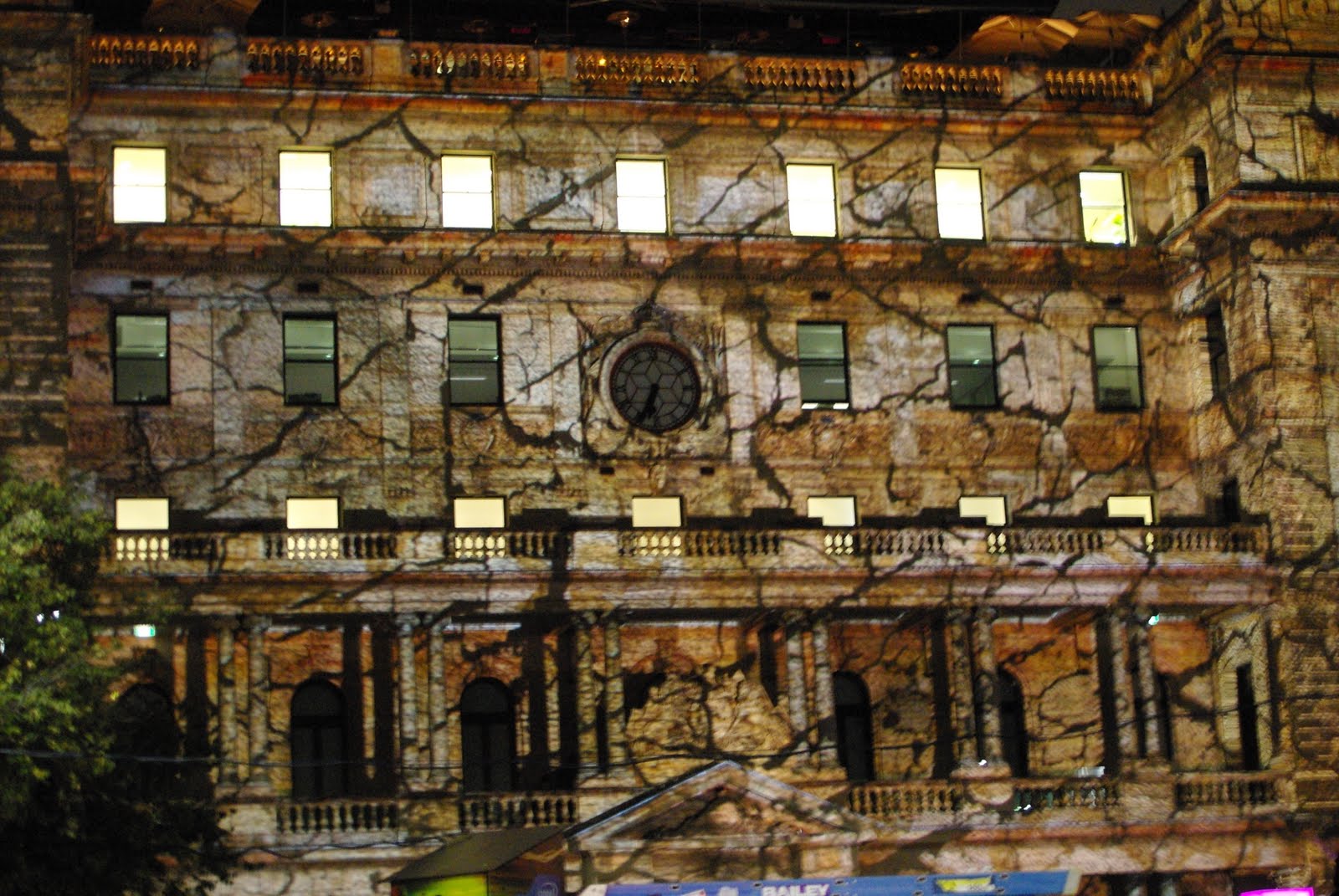
    VIVID FESTIVAL


    Have you seen the Sydney Vivid Festival? 'Get along little dawgy' as it's only on until the 13th June.
    You must see the Opera House, from 6pm any night and Customs House and Fire Dance at Campbell Cove.

    Our family favourite was the large stone, colonial facade of Customs House which turns into overflowing water, fire, glass, mercury and hundreds of abstract designs. We stood spellbound for 20 minutes.


    AUSTRALIAN FILM "TOOMELAH" SELECTED for CANNES

    CONGRATULATIONS IVAN - "TOOMELAH" has been SELECTED FOR OFFICIAL SELECTION - UN CERTAIN REGARD - in the 64th CANNES INTERNATIONAL FILM FESTIVAL of 2011

    Toomelah is the new feature film from Australian director, Ivan Sen. It is his second film to be released since his debut film "Beneath Clouds". It played in competition at the 2002 Berlin Film Festival, where it won the "Best First Movie Award". The film is set entirely in the remote Indigenous community of Toomelah, located on the NSW, QLD border. It was created as a mission during the 1930s, bringing together Gamilaroi and Bigambal people from the surrounding area. Continue reading...

    "To be honest, the Cannes invitation was a huge relief. Toomelah is a pretty unique movie, which was made in a very unorthodox way. I try not to get too carried away about festivals, but Toomelah the community, is my family's home, and I'm so proud of them all. I'm related to almost everyone there, and almost half the population pops up in the film. It will be an honour to take the movie and cast to Cannes. One of them has never been on a plane before, and the lead actor Daniel, has only been as far as Brisbane." Writer/ Director, Ivan Sen.

    Ivan Sen was raised in Inverell, New South Wales, Australia. He graduated with a degree in photography at Griffith University in Queensland. He studied filmmaking at the Australian Film Television and Radio School, where he completed a Bachelor of Arts in Directing in 1997. Throughout the late 1990s Sen worked on numerous short films, before making his feature film debut with Beneath Clouds in 2002. The film follows two teenagers, Lena (Dannielle Hall) and Vaughn (Damian Pitt) who hitch-hike together to Sydney. It won Sen global acclaim, winning a Silver Bear at the 2002 Berlin Film Festival, Best Director at the 2002 Australian Film Institute Awards and screened at the 2003 Sundance Film Festival, Sen has subsquently written and directed a number of award winning documentaries. His documentary Yellow Fella screened in Un Certain Regard at the Cannes Film Festival in 2005.

    The science of happiness


    Positive psychology is not just amateur self-help. It is a serious scientific discipline based on solid, empirical research.

    The Happiness Institute
    , in Australia, puts the principles of positive psychology into practice by providing key strategies and action plans, amongst other things, that can help us all live a happier life.
    Did you know it has been proven that optimistic people are much less likely to die of heart attacks than pessimists?

    As the founder and Chief Happiness Officer of The Happiness Institute, Dr. Happy is frequently asked about happiness. 

    As such, we thought you might like to see some of the more common questions along with his responses. 

    Q: What is The Happiness Institute and what’s your role there? 
    A: The Happiness Institute was Australia’s first, and remains its only, organisation focused solely on promoting happiness in individuals, couples, families and organisations. After working for more than a decade as a clinical psychologist I established The Happiness Institute in an attempt to promote the principles of positive psychology. Rather than helping people go from minus 10 (i.e. distress) to zero (i.e. normal), I wanted to spend more time helping people go from zero to positive 10 (real and meaningful happiness). At The Happiness Institute we promote happiness through our coaching, courses and consulting activities by teaching the proven and effective strategies that have evolved from the exciting new field of positive psychology. This includes (among other things) teaching optimistic thinking skills, helping individuals and groups identify and utilise their core strengths, and encouraging as many as possible to build positive relationships. My role is as founder and CHO (Chief Happiness Officer). My responsibilities primarily revolve around developing and delivering happiness programs, training others to deliver our programs and increasingly, consulting with organisations to enhance happiness and positivity within their teams and businesses. I also spend much of my time educating the public about happiness and positive psychology coaching, as well as writing and speaking. 

    Q: What exactly is “happiness”? 
    A: Happiness, for us here at The Happiness Institute, is a term that covers a range of positive emotions. Ultimately it means different things to different people; it’s an entirely subjective experience. For some, the experience of happiness is one of predominately “high arousal” feelings such as joy and excitement; for others, it involves more “low arousal”, but equally important, emotions such as calm, contentment, peace and tranquillity. Ideally, we should all try to experience and enjoy all these different forms of positive emotions but the reality is that some people will tend more to the high arousal end of the spectrum (e.g. extroverts) while others (e.g. introverts) might be more likely to seek out low arousal forms of happiness.

    It should also be noted, here, that at The Happiness Institute we don’t believe anyone will be 100% happy 100% of the time. True happiness involves recognising that as humans it’s perfectly normal to experience the full range of emotions including so called “negative” ones such as anger, sadness, anxiety and stress. They key, however, is responding to and managing these emotions so that they don’t unduly or excessively impact on functioning and that they don’t persist for too long. Where possible, it’s also important to try to learn from unpleasant and difficult circumstances as doing so can actually enhance happiness in the long term.

    Q: What do people think will make them happy, as compared to what actually makes them happy? 
    A: One of the biggest mistakes many people make is to think they’ll find happiness in “external” things such as money and/or material possessions. Although these things aren’t “bad” we know from the research, and from our considerable experience in this area, that the positive feelings we get from “stuff” is only short lived, it’s only temporary and relatively superficial. In contrast, what really contributes to real and meaningful happiness are variables such as good quality relationships, optimistic thinking, compassion for others, the ability to identify and utilise strengths and the practice of strategies such as appreciation and gratitude. In fact, at The Happiness Institute we believe happiness is something you choose (see “The Happiness Institute’s CHOOSE philosophy – 6 powerful positive psychology strategies”). 

    Q: How dependent is happiness on favourable events in one's life? How dependent is happiness on a predisposition to be happy? 
    A: Partly and partly! Anyone experiencing significant negative (or traumatic) events will find it harder to be happy. At the same time, happiness depends less on what happens to us and more and how we think about (or interpret) what happens to and goes on around us. There’s no doubt that happy people think about the world in a fundamentally different way – a more optimistic way. Optimistic thinking is certainly positive thinking but it’s also realistic thinking. So even when bad things happen to happy people they think about events in a constructive and helpful way, looking for solutions rather than just focusing on problems. As for a happiness predisposition – there’s no doubt that as “biological animals” our happiness is partly dependent on our genes. But the contribution of predisposing factors to happiness is only about 30-50% which means there’s at least 50-70% of our happiness that’s within our control! As noted above, at The Happiness Institute we believe happiness is something you “choose” and it’s the choices we make, every minute of every day that largely determine our happiness. 

    Q: What effect does the self-comparison between oneself and another have on happiness levels? 
    A: Comparing ourselves to others, as a general rule, is not very helpful – especially if we compare ourselves to others who’re “better off” than we are on whatever we’re comparing. For instance, those people who compare themselves to others who’re wealthier tend to feel dissatisfied with what they have (i.e. unhappy). At the same time, however, those who compare themselves to others who’re lower on the socio-economic ladder tend to feel better.

    I’d encourage people to consider that seeking happiness is in all of our interests as happy people are more generous, more altruistic and they do more good things for others. If we all, at home and at work, do more to create happy and positive environments then we’ll all, ultimately benefit. Happiness should, in any context, be considered a front line priority! 

    For more information about The Happiness Institute’s coaching, courses or corporate consulting activities please feel free to email or call. After all…life’s too short not to be happy! 

    www.thehappinessinstitute.com
    ph:02 9221 3306
    info@thehappinessinstitute.com

    Monday

    Good Art - A picture tells a thousand words

    Good Morning,

    Have you ever thought about why you like a particular artwork?

    If you walk around any art gallery you will hear people saying "I like that ", " Oh wow, I like that one! " We all have done it.

    Lately it dawned on me that the common link in the kind of art I admire is that the artist creates a world. It may be a strange idiosyncratic world, a kooky world, a raw edgy world, a romantic world or a mysterious world but it makes me want to find out more about the place...the place that the artist has created... and the good thing is I can visit that place in their creations. I can travel to new lands without leaving my house.

    I admire these artists. Yes we all create - food, letters, our persona, our home, our lifestyle some create children but to create another whole world now that is seriously good.

    Here is a short list of artists I am enjoying for this reason:

    Eric Frietas and his amazing, moving, metallic world
    Eric Orchard illustrates story books and comics amongst other things.
    Greg Spalenka ancient world mystical illuminations
    Tod Seelie photographs the everyday with an edge
    Kinuko Y. Craft romantic fairy tale story world

    They all have amazing sites too as you would expect from artists.
    If you are a visual person, like me, here are some of their worlds. But I am not going to tell whose is whose - you will have to visit their sites to find out.
    (If any one cares to identify them all correctly in comments I will send you a prize!)
    " No great artist ever sees things as they really are... If he did, he would cease to be an artist. " comment by Oscar Wilde (please excuse him his use of the masculine.)

    Tuesday

    Good things come in small packages


    Making things with our hands is good for the soul
    These things are just so cute and just ooze goodness. Little felt gnomes and pixies in purses and handmade felt animals.
    Shannon also is generously good - showing us all how to create many of her good things: beautiful fleece birds
    peg doll flowers